A silicone hose is a flexible hose made mainly from silicone rubber. It is widely used to transfer air, water, coolant, gases, and other compatible fluids in automotive, industrial, food-processing, healthcare, and other applications. Compared with many conventional rubber hoses, silicone-based constructions can offer a useful combination of temperature resistance, flexibility, and environmental durability.
For B2B buyers, choosing the right hose is not simply about selecting silicone as the material. The application, working temperature, pressure or vacuum, fluid compatibility, dimensions, reinforcement, and connection method all affect product selection. Understanding these factors can help importers, distributors, OEMs, and engineering buyers specify the right product for their projects.
What Is a Silicone Hose?
A silicone hose is typically produced from silicone rubber and may include one or more reinforcement layers. Depending on the application, manufacturers can use polyester, fiberglass, aramid, or wire reinforcement to improve pressure resistance, dimensional stability, or performance under demanding conditions.
Silicone compounds can also be formulated or lined for specific media. For example, fluorosilicone or FKM lining can improve resistance to fuels, oils, and certain chemicals. This allows different hose constructions to be developed for applications that require more than basic air or water transfer.
The final structure depends on the working environment. A simple unreinforced tube may be suitable for a low-pressure application, while an automotive cooling or turbo system may require multiple reinforcement layers. For this reason, product selection should start with the operating conditions rather than the hose material alone.
Main Types of Silicone Hoses
Silicone Hose for Coolant Systems
A silicone hose for coolant systems is designed to carry coolant between components such as the engine, radiator, expansion tank, and heater circuit. Automotive coolant products commonly use reinforced construction to maintain flexibility while handling elevated temperatures and pressure.
When selecting a coolant line, buyers should check the required temperature range, coolant type, pressure rating, inside diameter, and connection geometry. These details help prevent leakage, deformation, or premature failure during long-term operation.
Silicone Radiator Hose
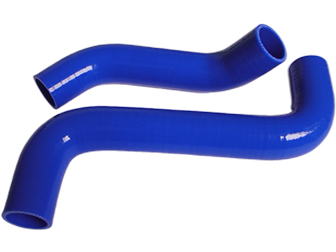
A silicone radiator hose connects the radiator with other parts of an engine cooling system. It needs to tolerate repeated heating and cooling cycles, vibration, pressure, and exposure to coolant.
For commercial vehicles, performance vehicles, and customized engine systems, hose dimensions and shape can vary considerably. Standard straight sections may be sufficient for some installations, while molded or formed designs can be more appropriate where space is limited.
Buyers should also consider wall thickness and reinforcement. These factors can influence pressure handling, flexibility, and resistance to deformation when the engine compartment experiences repeated temperature changes.
Silicone Heater Hose
A silicone heater hose is commonly used to transfer hot coolant between the engine and heater system. It should remain flexible at elevated temperatures and maintain reliable connections during engine operation.
For replacement or OEM-style projects, buyers should consider inner diameter, bend angle, length, wall construction, and coolant compatibility rather than relying only on a general hose size. A properly matched design can make installation easier and reduce stress at connection points.
Silicone Vacuum Hose
A silicone vacuum hose is used for vacuum lines and other low-pressure air applications. Its ability to remain flexible while resisting collapse can be useful in engine compartments and equipment exposed to heat.
For vacuum service, buyers should pay particular attention to wall construction, inside diameter, operating temperature, and the expected vacuum level. If the line is routed near a heat source, the selected material and construction should also be suitable for that environment.
Other Common Types
Other automotive constructions include turbo, air intake, charge air cooler, fuel cell, and hybrid hoses.
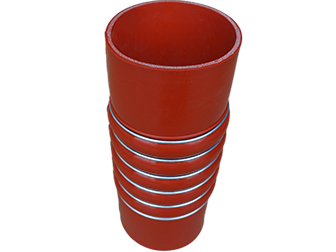
Special-purpose designs can also include wire-reinforced, aramid-reinforced, fiberglass-reinforced, chemical-resistant, and fire-retardant versions.
These variations allow manufacturers to adjust the hose structure for different pressure, temperature, flexibility, chemical, or mechanical requirements.
Where Are Silicone Hoses Used?
Silicone hoses are used across several industries. In automotive systems, they can be found in cooling, heating, air intake, turbocharger, charge air, vacuum, fuel cell, and hybrid applications. Industrial equipment may use them for air, water, gas, and other compatible media.
Food-processing machinery and beverage equipment can require food-contact-grade silicone tubing or reinforced hose. Healthcare equipment may also use silicone components where material properties and cleanliness requirements are important. Railway, marine, agricultural, and mechanical equipment are other potential application areas.
For OEMs, importers, distributors, and engineering buyers, the important consideration is whether the hose construction matches the actual service conditions. A product designed for water or coolant should not automatically be used with fuel, oil, or aggressive chemicals. Material compatibility should always be confirmed before production or installation.
Application requirements can also differ within the same industry. For example, an engine cooling system and a turbocharger system may both operate at elevated temperatures but require different hose constructions. The correct product therefore depends on the complete set of operating conditions.
Key Benefits of Silicone Hoses
Temperature Performance
One major advantage of silicone rubber is its ability to maintain useful performance across a broad temperature range. Some reinforced vehicle hose constructions supplied by SUNRISE are designed for approximately -54°C to +260°C, depending on the specific product, compound, reinforcement, and application.
The actual working range should always be confirmed from the product specification. Continuous operating temperature, short-term temperature peaks, fluid temperature, and surrounding conditions can all affect service performance.
Flexibility
Silicone remains relatively flexible compared with many rigid materials. This can simplify routing around engine components and equipment. Different reinforcement structures can also be selected when buyers need a balance between flexibility and dimensional stability.
For systems with tight installation spaces or complex routing, the hose shape can be an important part of the design. Custom bends and formed sections may help reduce unnecessary stress on connections.
Environmental Resistance
Silicone materials can provide resistance to ozone, UV exposure, weathering, and aging. These properties can be useful for equipment operating outdoors or in engine compartments where temperature and environmental conditions change frequently.
However, environmental resistance does not mean that every silicone construction is suitable for every chemical or fluid. Compatibility should still be checked against the actual medium and operating conditions.
Reinforcement Options
Reinforcement is an important part of hose design. Polyester, fiberglass, aramid, and wire can be used to improve strength, pressure handling, vacuum resistance, or dimensional stability. The appropriate construction depends on the application rather than a single universal specification.
Different reinforcement levels can also influence flexibility and bendability. Buyers should therefore consider the complete balance between pressure requirements, installation space, movement, and service temperature.
How to Choose the Right Product
Before ordering, B2B buyers should confirm several basic requirements:
6.Reinforcement and lining: Select polyester, fiberglass, aramid, wire, fluorosilicone, FKM, or other constructions according to service requirements.
For custom projects, a technical drawing, existing sample, dimensions, photos, or application information can help the manufacturer evaluate the required construction. SUNRISE can develop custom hose products based on drawings, samples, or application requirements and can discuss material, reinforcement, dimensions, and production details before bulk manufacturing.
For overseas buyers, it is also useful to confirm production requirements before placing a large order. This can include sample approval, material specifications, dimensions, tolerances, packaging, labeling, and inspection requirements. Clear technical information helps reduce misunderstandings between the buyer and manufacturer.
Conclusion
The right hose should be selected according to the application rather than the material name alone. Temperature, pressure, vacuum, fluid compatibility, dimensions, reinforcement, and connection requirements all influence the final specification.
For standard replacement needs, a suitable catalog product may be enough. For OEM, aftermarket, or specialized equipment projects, a custom design can provide a better fit. Sharing drawings, samples, and operating conditions with the manufacturer is a practical way to confirm the specification before bulk production.
For B2B buyers sourcing from China, discussing the application and technical requirements with the manufacturer at an early stage can also help determine the appropriate material, reinforcement, dimensions, and production method.
FAQ
How to choose the right silicone hose for an engine?
Start with the engine system and the medium being transferred. Check the required temperature, pressure or vacuum, inside diameter, outside diameter, bend shape, length, and connection type. For coolant, radiator, heater, intake, turbo, or vacuum applications, the construction should match the specific operating conditions. If the required shape or size is not standard, provide a drawing or sample for evaluation.
Recommended clamps for high-pressure silicone hose connections
The clamp should match the hose outside diameter and the connection design. For higher-pressure applications, constant-tension clamps or T-bolt clamps may be considered depending on the operating conditions. The clamp should provide secure compression without cutting into or excessively deforming the hose wall. Clamp selection should also consider temperature, vibration, and pressure changes.
What temperature range can silicone hoses withstand?
There is no single temperature range for every silicone hose. Performance depends on the silicone compound, reinforcement, wall thickness, construction, and application. Some SUNRISE reinforced vehicle products are designed for approximately -54°C to +260°C. Buyers should always check the temperature specification of the specific product rather than applying a general range to every hose.

Sunrise Silicone Hose Co., Limited


Dirección : Suite 805, No. 341 Jiahe Road, Xiamen City, Fujian Province, China
Correo electrónico : sales@siliconehose-china.com