Two hoses may both carry a food-grade label, yet perform differently in the same production line. A suitable choice for cool beverage transfer may not suit hot cleaning cycles, repeated compression, or a different food formulation.
For equipment manufacturers and food processors, the question is not simply whether silicone is better than PVC. It is which finished product fits the application, with documentation supporting its intended use. This guide compares the practical selection factors and explains what buyers should check when researching an
FDA food-grade silicone hose.
Key Takeaways
-
Food-contact suitability depends on the formulation and intended use.
-
Evaluate production temperatures and cleaning conditions separately.
-
Compare working pressure at the actual hose size and temperature.
-
Match compliance documents to the supplied product and application.
Silicone vs PVC: Start with Equivalent Products
A meaningful comparison starts with food-contact products on both sides. Comparing a documented silicone line with an unspecified industrial PVC tube does not help buyers make a sound decision.
Both materials are available in products intended for food and beverage applications. However, their suitability depends on the formulation, construction, operating conditions, and supporting documentation.
Selection Factor
|
Food-Contact Silicone Hose
|
Food-Contact PVC Hose
|
Temperature
|
Evaluate the specific grade for production and cleaning exposure.
|
Verify the formulation’s temperature limits and related pressure restrictions.
|
Construction
|
Distinguish flexible tubing from reinforced transfer hose.
|
Distinguish unreinforced tubing from braided or otherwise reinforced products.
|
Flow visibility
|
Confirm whether the product is translucent, transparent, or opaque.
|
Clear formulations can help operators observe flow and visible residue.
|
Cleaning
|
Confirm chemical compatibility and any steam restrictions.
|
Confirm chemical compatibility and cleaning-temperature limits.
|
Documentation
|
Check the intended food-contact conditions.
|
Check the intended food-contact conditions.
|
For an ambient-temperature transfer line, a documented PVC product may meet the process requirements without a material change. Where hot cleaning or repeated thermal exposure is involved, a silicone alternative deserves evaluation against the complete operating cycle.
Neither decision should rely on the material name alone. Compare a food-grade silicone hose with a PVC alternative of equivalent dimensions and mechanical duty.
What Does “FDA Food-Grade Silicone Hose” Mean?
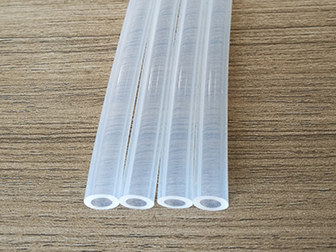
For buyers, compliance matters more than a label.
FDA refers to the U.S. Food and Drug Administration. In a product description, the term should point to an identifiable food-contact compliance basis, not serve as a general promise of safety under every condition.
A commonly relevant U.S. food-contact regulation for silicone rubber is 21 CFR 177.2600, "Rubber articles intended for repeated use." It addresses permitted ingredients and extractive limits, including requirements associated with aqueous and fatty foods. These provisions do not establish unrestricted suitability for every finished hose or application. (Source: eCFR)
A reference to this regulation therefore needs context. What material or product does the statement cover? What contact conditions were evaluated? Does the supporting information apply to the hose being supplied?
Look Beyond a General Compliance Statement
When reviewing an FDA food-grade silicone hose, check whether the available documents identify:
-
The product, material, or formulation covered.
-
The applicable regulatory requirements.
-
The sample and test conditions, where testing is provided.
-
Relevant food-contact categories and restrictions.
-
A clear connection between the documentation and the supplied item.
A raw-material declaration, laboratory report, and finished-product compliance statement provide different information. One should not automatically be treated as a substitute for another.
Also distinguish “FDA-compliant” from language implying that FDA issued a certificate for the individual hose. A third-party laboratory report does not, by itself, constitute FDA-issued product approval.
Temperature: Consider the Entire Operating Cycle
A line carrying a cool liquid may experience its highest temperature during cleaning. Reviewing only the normal transfer temperature can miss an important limitation.
Record the production temperature, cleaning temperature, exposure duration, and frequency separately. Then evaluate them against the finished product’s specifications.
Silicone options are often considered where elevated temperatures or repeated thermal exposure are important. However, the allowable conditions remain product-specific. Reinforcement, dimensions, pressure, and exposure time can all affect the suitability of a particular assembly.
PVC alternatives likewise require a clear assessment of temperature limits. A product suitable for cool transfer should not be assumed suitable for a hot wash cycle.
Do not combine three different questions into one:
-
Can the material tolerate the temperature?
-
Is the food-contact use supported under those conditions?
-
Is the proposed cleaning or sterilization procedure permitted?
A maximum temperature figure cannot answer all three. In particular, suitability for a defined steam sterilization cycle does not automatically establish suitability for continuous steam service.
Pressure, Vacuum and Pumping Need Separate Checks
An unreinforced tube and a braided pressure hose are not equivalent, even when they share the same base material.
Evaluate working pressure for the actual size and operating temperature. Reinforcement can improve pressure capability, but the rating belongs to the finished product, not to silicone or PVC as a material category.
Burst pressure should not be used as an allowable operating pressure. Similarly, a positive-pressure rating does not establish resistance to collapse during suction duty. Vacuum applications need their own confirmation.
For peristaltic equipment, food grade silicone tubing must also match the pump’s dimensional and mechanical requirements. Repeated compression creates a different duty from ordinary liquid transfer. Food-contact documentation alone does not establish pump compatibility or service life.
The practical approach is to distinguish transfer hose, reinforced pressure hose, and pump tubing before comparing materials. Selecting the wrong construction cannot be corrected simply by choosing a different polymer.
Match the Hose to the Food and Installation
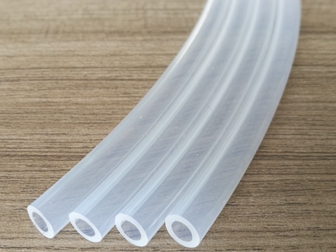
“Food” is not a single compatibility category.
Water-based beverages, dairy products, oily foods, and alcohol-containing mixtures can require different assessments. The applicable contact conditions and the material’s resistance to the actual fluid both matter.
A food safe silicone hose label should not be interpreted as permission to carry any edible liquid. Regulatory suitability concerns permitted food-contact use; compatibility concerns performance in the actual medium.
Use the application to guide the review:
-
For beverage transfer, assess documented contact conditions and any need for visible flow inspection.
-
For coffee equipment, consider hot-fluid exposure and the cleaning procedu
-
For dairy or oily foods, confirm the relevant contact conditions and fluid compatibility.
-
For dosing equipment, evaluate pump requirements alongside the liquid being handled.
Installation deserves attention too. Confirm dimensions, routing, connection details, and available space. A straight length, molded bend, and reinforced assembly may solve different installation problems.
The aim is to match the complete product to the process, rather than select by industry name alone.
Compare Quality and Cost on the Same Basis
Price becomes meaningful only when the specifications match.
Before comparing alternatives, check internal diameter, wall thickness, reinforcement, operating conditions, and documentation scope. A standard clear transfer line and a custom molded connection are different purchasing decisions, even if both handle the same liquid.
Avoid assuming that the more expensive option will last longer or that silicone will always reduce lifetime costs. Those conclusions need application-specific evidence.
A useful cost assessment considers installation, cleaning restrictions, maintenance, and documented replacement experience as well as purchase price. Where service-life information is unavailable, acknowledge the uncertainty instead of assigning a general lifespan to the material.
For readers exploring the available constructions, SUNRISE’s food-grade range offers a starting point for comparing standard tubing, reinforced hose, and molded configurations. Use the relevant technical information to assess the options against the actual process, rather than relying on the category label.
FAQ
What temperature ranges are suitable for food grade silicone?
There is no single range for every finished product. Allowable temperatures depend on the compound, construction, pressure, and exposure duration. Check continuous-operation limits separately from intermittent exposure and cleaning conditions. If a datasheet lists only a maximum temperature, confirm the conditions behind that figure before using it in a design.
What are the key advantages of using food grade silicone hose?
Depending on the formulation and construction, useful characteristics can include flexibility, accommodation of temperature changes, and availability in reinforced, pump-tubing, or molded configurations. Their value depends on the application. They do not make silicone automatically safer or more suitable than a documented PVC alternative.
How do I properly clean and sanitize a food grade silicone hose?
Follow a validated procedure compatible with the hose and connected equipment. Confirm the cleaning agent, concentration, temperature, exposure time, and rinsing requirements. Inspect for deterioration or residue afterward. Do not assume that stronger chemicals or steam are acceptable without checking product restrictions. Cleaning, sanitizing, and sterilizing are different operations; use the procedure required for the process.